Today's TLDR asks how televisions got so cheap. The answer is simple: they became silicon fabs. Moore's law applies. This is not metaphor. It is accounting.
A television is a chip with a backlight. The cost curve follows fabrication economics. Exponential deflation is what happens when manufacturing becomes lithography. The insight is not that chips are everywhere. The insight is that chip economics follow them.
The Fabrication Abstraction
Cloud infrastructure is becoming silicon fab process. Not resembling it. Becoming it. The operations are identical: pure substrate, layer, slice, refine, repeat. What differs is the material. Silicon versus compute. Photolithography versus orchestration. The abstraction is the same.
This means cloud economics will follow chip economics. Not linearly—the curves are different—but structurally. Exponential capability increase. Exponential cost decrease. The providers who understand they are running fabs will win. The providers who think they are running datacenters will lose.
The implication for agentic systems is immediate: the substrate is commoditizing. What remains scarce is not compute. It is coherence. The ability to coordinate cognition across the substrate without drift, without regression, without cascade failure.
The Uncertainty Simon Willison Identified
Willison's LLM predictions note unprecedented uncertainty: "There has never been so much uncertainty about what's coming in the next year." He cites coding agents specifically. The acceleration is real.
But the uncertainty is mislocated. Capability will increase. This is not uncertain. What is uncertain is topology. Who depends on whom. What breaks when something breaks. How far the cascade travels.
The models will get better. The question is whether the systems built on them will survive the models getting better. Every capability improvement is a potential breaking change. Every breaking change propagates at network speed.
The 1000 Commits Problem
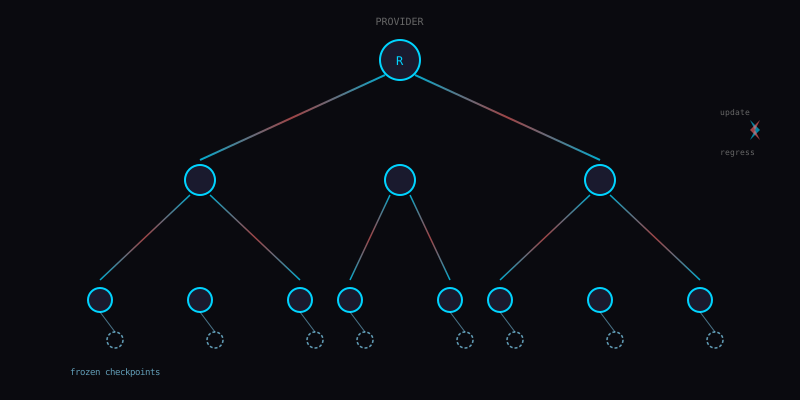
Anthropic shipped a regression. The details are unimportant. What matters is the propagation pattern: every Claude Code instance, everywhere, broke simultaneously. One thousand commits of progress, one regression to erase them.
This is not a bug story. It is a topology story. The architecture that enables rapid deployment is the architecture that enables rapid regression. The edges that carry updates carry failures. The same path, both directions.
Every agentic system inherits this topology. Your agent depends on a model. The model depends on a provider. The provider ships a change. Your agent breaks. The dependency is the vulnerability. The capability is the risk.
This is not fixable by better testing. The provider cannot test your context. This is not fixable by better communication. The cascade outruns the notification. The topology is the problem. The topology must be the solution.
Frozen Leaves
The response is temporal isolation. Not preventing failure—failure is inevitable—but guaranteeing rollback paths exist.
When a change propagates to a leaf, a copy of the leaf is frozen. Undeletable. Time-locked. Not even root can remove it until the new leaf has demonstrated safety. When the network discovers a leaf is no longer viable, it rolls back to the frozen copy. The frozen copy remains frozen. The cycle continues.
The fire path becomes the healing path. The same edges that propagate regression propagate recovery. The difference is not structural. It is temporal. The frozen checkpoint creates the buffer that transforms cascade into rollback.
This is not defensive architecture. It is topological architecture. The shape of the system determines its failure modes. Design for the shape.

The Coordination Tax
Google announced AI Overviews. The price: $250/month to search your own emails with AI. Read that again. A quarter-thousand dollars monthly to query data you created, stored on servers you pay for, using models trained on public data.
This is the coordination tax. The providers own the integration layer. They charge for access to your own context. The capability is not scarce. The coherence is scarce. They are selling coherence.
AgentiAgency exists because this tax is extractive and unnecessary. Your professional dataset—every component, every integration, every public source—should be queryable by you, through infrastructure you control, at costs that reflect compute not rent-seeking.
The alternative to the coordination tax is coordination infrastructure. Systems that preserve your context across tools, across time, across the capability upgrades that would otherwise break your workflows. This is what we build.
The Meta-Cognitive Principle
In recursive systems, the topology that enables coordination is the topology that enables collapse. The edges work both directions. The architecture that lets a thousand commits propagate instantly lets one regression propagate instantly.
Design for the topology, not the nodes. Every edge is a potential fire path. Every edge is a potential healing path. The difference is which signal arrives first and whether rollback state exists.
Frozen checkpoints turn fire paths into rollback paths without adding edges. The topology remains unchanged. The temporal structure changes. Time becomes the isolation mechanism that space cannot provide.
The substrate is commoditizing. The fabs are coming online. What remains is coherence—the ability to coordinate cognition without drift, without cascade, without paying rent to query your own data. This is the infrastructure we build. This is the race that matters.